
 By
·
9 minute read
By
·
9 minute read
Product owner stakeholder management is becoming a make-or-break discipline for manufacturers running complex portfolios of smart, connected products. When stakeholder expectations are unclear or misaligned, capital is locked into the wrong variants, plants absorb avoidable disruption, and digital initiatives stall before they ever hit the shop floor.
For executives, this is not an abstract governance issue but a direct driver of margin, lead time, and customer satisfaction. Effective product owner stakeholder management ensures that engineering, plants, supply chain, and commercial teams commit to the same roadmap, the same trade-offs, and the same definition of success, so every sprint and every stage-gate moves the enterprise toward measurable ROI.
Defining Product Owner Stakeholder Management
In a manufacturing context, the product owner is the orchestrator between strategy and execution, translating market intent into a prioritized backlog that engineering and plants can deliver. Stakeholder management is the discipline of engaging the many parties who influence the backlog so their needs are visible, negotiated, and reflected in clear decisions.
Unlike pure software environments, manufacturing product teams must reconcile agile iterations with long tooling lead times, regulatory approvals, and stage-gate processes for new product introduction. Product owners are therefore continuously balancing software sprints with physical constraints such as capital equipment, line capacity, and minimum order quantities, while still keeping stakeholders aligned on deadlines and scope.
This complexity multiplies with cyber-physical products that blend mechanical systems, electronics, and embedded software. Here, stakeholder management means ensuring IT and OT leaders, firmware teams, manufacturing engineering, and service organizations share a common view of dependencies, from software releases that change field behavior to hardware revisions that require new work instructions. Many manufacturing product leaders formalize this landscape using extended stakeholder registers and capability models similar to those described in resources on what product managers in manufacturing need to succeed, ensuring nothing critical is left out of the conversation.
A Manufacturing Stakeholder Map and Priorities
Because manufacturing value chains are so interconnected, product owners benefit from an explicit stakeholder map that clarifies who cares about what, and which KPIs they are optimizing. This avoids the common pattern where sales pushes for more variants, operations pushes for fewer changeovers, and no one has a shared view of the trade-offs.
| Stakeholder | Primary goals and KPIs | Risk if misaligned with product decisions |
|---|---|---|
| Plant manager | OEE, throughput, on-time delivery, line stability | Unplanned changeovers, overtime, missed shipments |
| Quality leader | Scrap rate, rework, defects per million, recalls | Warranty claims, reputational damage, regulatory issues |
| Procurement and supply chain | Material cost, supplier reliability, inventory turns | Stockouts, excess inventory, supply disruption |
| R&D and engineering | Innovation velocity, design re-use, compliance | Overengineered products, slow releases, redesign cycles |
| Sales and marketing | Revenue growth, win rate, portfolio fit by segment | Uncompetitive offers, overpromising lead times or features |
| After-sales and service | First-time fix rate, uptime, service cost, NPS | Poor customer experience, high service overhead |
| Regulatory, HSE, and compliance | Safety, standards adherence, audit readiness | Fines, recalls, delays due to non-compliance |
When product owners maintain and revisit a map like this across the lifecycle—from concept through ramp-up, mass production, and obsolescence—it becomes much easier to know who must be involved in which decisions, and whose KPIs will move when a product change is proposed.
Why Stakeholder Management Drives ROI
For manufacturing executives, stakeholder engagement is often viewed as a “soft” competency, yet its impact is visible in hard metrics. Clear alignment among stakeholders determines how fast new variants reach the market, how much scrap and rework arise during ramp-up, how reliably plants hit takt time, and how much working capital is tied up in the wrong inventory mix.
Data from the Deloitte 2025 Smart Manufacturing Survey shows that 72% of manufacturers assigning a dedicated product owner to every smart-factory program report ROI that meets or exceeds expectations within two years. That correlation underscores how critical it is to have someone explicitly responsible for orchestrating stakeholder input and translating it into a backlog that protects value.
The World Manufacturing Forum 2024 Annual Report notes that 68% of global manufacturing leaders increased cross-functional product-team budgets to improve stakeholder alignment and time-to-market. Those investments are fundamentally about giving product owners the time, tools, and forums to keep operations, commercial, and technology stakeholders synchronized.
Meanwhile, the PwC Responsible AI Survey 2025 reports that 56% of executives now see first-line teams (like IT and Engineering) as primary owners of digital governance initiatives. This shift of decision power closer to execution makes day-to-day product owner stakeholder management essential; governance routines alone can no longer keep complex roadmaps and global factories in lockstep.
Practically, strong stakeholder management reduces the “decision latency” that often cripples Industry 4.0 programs, shortens feedback loops between plants and product teams, and ensures that scarce capital flows into the variants and capabilities with the highest measurable cost, revenue, and risk impact.
8 Best Product Owner Stakeholder Management Tips
With that context, the question becomes how manufacturing product owners can operationalize stakeholder management without turning it into bureaucracy. The following eight tips focus on pragmatic, executive-level practices that connect strategy, plants, and portfolios—and that scale across regions and product lines.
Tip 1: Ground Product Owner Stakeholder Management in a Shared ROI Narrative
Every major initiative should start with a single, shared ROI story that all stakeholders recognize as their own. For manufacturing, that narrative connects product decisions not just to revenue projections, but also to OEE, scrap, changeover time, lead-time reliability, and service cost.
One early-adopter cohort of U.S. smart-factory programs described in the NAM 2025 Manufacturing Trends report used a Product-Owner Stakeholder Council plus joint OKR workshops to build that shared narrative. Within 12 months, they achieved lower unit costs, faster decision cycles, and higher OEE than late adopters, because every stakeholder could see, on live dashboards, how incremental product releases affected the KPIs they cared about.
For executives, the lesson is clear: insist that product owners translate stakeholder input into KPI Set Roadmaps that explicitly tie backlog items to financial and operational outcomes. This creates a factual foundation for prioritization and reduces political debates about which feature, variant, or plant upgrade should move first.
Tip 2: Use a Structured Stakeholder Process Tailored to Manufacturing
Relying on informal relationships is risky when your portfolio spans plants, regions, and cyber-physical systems. Product owners need a repeatable, manufacturing-aware process to identify, analyze, and engage stakeholders so that no critical voice is missing when tooling, platform, or variant decisions are made.
A practical, five-step approach looks like this:
- Identify stakeholders across the lifecycle for each product family, including plant roles, suppliers, regulators, and service organizations.
- Analyze their influence and interest using an influence/interest grid specific to manufacturing KPIs and constraints.
- Clarify decision rights with a RACI matrix that covers design changes, supplier switches, feature de-scopes, and regional variant approvals.
- Define engagement cadences: which stakeholders join sprint reviews, which attend stage-gate boards, and which receive only periodic updates.
- Review and adjust the map each quarter as programs move from concept to pilot, ramp-up, and sustaining.
Tip 3: Make Agile Work with Stage-Gate and NPI, Not Against It
Many manufacturers struggle to reconcile agile product ownership with rigid NPI and stage-gate processes. The result is friction between teams working in sprints and governance bodies that expect long-range, frozen requirements, leading to stakeholder frustration on both sides.
Product owners can resolve this by using dynamic roadmaps that show how sprint-level backlogs roll up into gate deliverables, explicitly mapping dependencies between software, electronics, and mechanical components. Approaches described in agile implementation strategies for manufacturing excellence demonstrate how timeboxed experiments and learning cycles can coexist with formal gate approvals when expectations are clear.
In practice, this means presenting gates not as one-way doors, but as investment checkpoints where stakeholders can see how validated learning from previous sprints has de-risked the next increment. When product owners frame agile in this way, plant managers and executives gain confidence that flexibility will not undermine schedule discipline or compliance.
Tip 4: Engage the Shop Floor Before Locking in Product and Process Decisions
Operators, technicians, and line supervisors often see the practical consequences of product decisions long before they show up in financial reports. Yet they are frequently the last stakeholders consulted, leading to workarounds, hidden rework, and resistance when new variants or processes arrive.
Manufacturing-savvy product owners treat the shop floor as a primary stakeholder, not a downstream recipient. They schedule regular Gemba walks, invite line representatives into design-for-manufacturability reviews, and pilot new variants on a limited number of lines with structured feedback loops before global rollout.
This early engagement surfaces issues such as tooling change complexity, ergonomic risks, or quality traps while it is still cheap to adjust the design. It also builds trust, because plant teams see their feedback directly reflected in backlog changes and work-instruction updates, rather than being asked to “make it work” after decisions are locked.
Tip 5: Align global plants and supply chain stakeholders in short, focused “Value Syncs”
Global manufacturers face a constant tension between centralized product strategy and regional realities such as local regulations, supplier issues, and demand shifts. If product owners rely only on quarterly reviews, decisions about variants, substitutions, or line sequencing lag far behind what plants and logistics teams need.
A European industrial automation company highlighted in the World Manufacturing Report 2024 on skills and resilience tackled this by instituting fortnightly cross-region “value syncs” led by the product owner. Connected to an end-to-end digital thread linking design, production, and supplier data, these sessions allowed stakeholders to re-prioritize backlog items against live supply-chain risk dashboards.
Within a year, they achieved shorter order-fulfilment lead-times, lower raw-material inventory, and significantly higher on-time delivery performance. The takeaway for executives is that frequent, focused stakeholder forums anchored in real-time data dramatically improve the agility and resilience of global product and manufacturing networks.
Tip 6: Use Portfolio-Centric Roadmaps and Connected Intelligence to Manage Complexity
As product lines fragment into multiple SKUs, options, and regional variants, single-product roadmaps quickly become inadequate. Product owners need portfolio-centric roadmaps that capture reusable modules, regional differences, and cyber-physical dependencies across hardware and software.
Modern roadmap platforms designed for manufacturing support dependency mapping between components and plants, KPI Set Roadmaps that quantify the business impact of each initiative, and modular architecture views that show where components can be reused rather than redesigned. They also provide connected roadmap intelligence, integrating data from PLM, ERP, and agile tools through Open API integrations so stakeholders always see one current view of the truth.
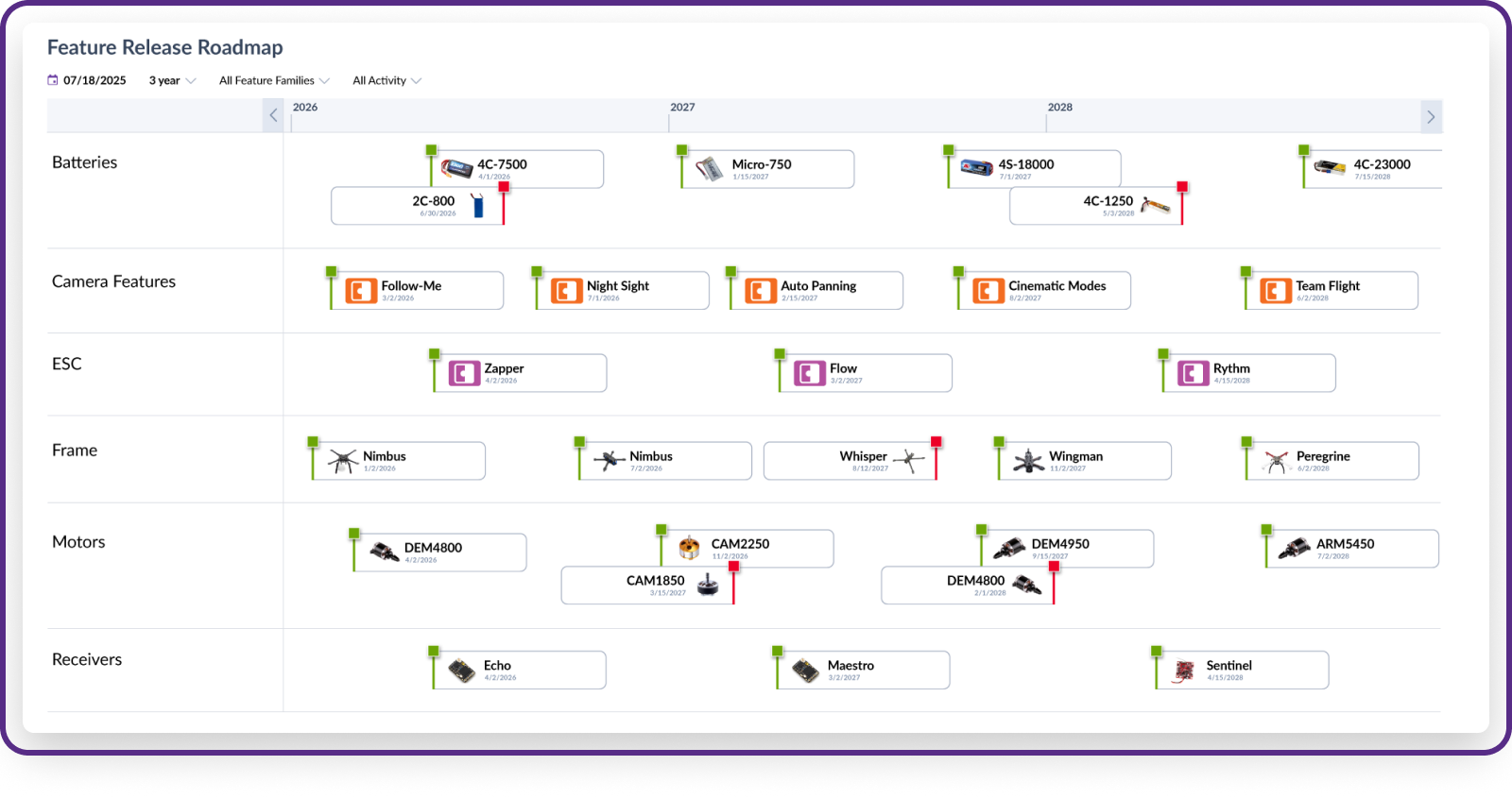 Manufacturing organizations that are ready to replace spreadsheet-based planning with purpose-built software can evaluate how Gocious product roadmap software unifies hardware and software development cycles on a single, portfolio-centric roadmap. The way Gocious aligns product strategy and execution across manufacturing organizations illustrates how such platforms give executives and product owners a shared, real-time lens on roadmap decisions and their downstream impact on plants and customers.
Tip 7: Manage Recurring Stakeholder Conflicts with Explicit Decision Rules
In manufacturing, certain conflicts are predictable: sales versus operations on lead times and mix, engineering versus plants on design complexity, corporate versus local markets on variant proliferation, and quality versus cost on inspection and test coverage. If these debates are resolved ad hoc, they consume executive time and erode trust in the product owner’s role.
Product owners can reduce friction by working with executives to define explicit decision rules and escalation paths. For example, they can agree that when cost, quality, and throughput conflict, the tie-breaker will be a structured, cost-of-delay assessment that includes tooling lead time, regulatory re-approval, and decommissioning costs, rather than a simple revenue forecast.
These rules should be documented in governance charters and reinforced in stakeholder councils and gate reviews. Over time, stakeholders learn that disagreements will be resolved consistently based on shared principles and data, which increases their willingness to support tough trade-offs and minimizes the need for last-minute executive intervention.
Tip 8: Measure and Communicate the Impact of Stakeholder Management
To sustain executive sponsorship, product owners must demonstrate that better stakeholder management is not just “good collaboration” but a measurable performance driver. That requires a small, focused metrics set that ties engagement practices to operational and financial outcomes.
Typical measures worth tracking include:
- Manufacturing performance: OEE, scrap and rework, changeover time, and ramp-up stabilization duration for new or modified products.
- Flow and responsiveness: time-to-market for new variants, engineering change cycle time, and decision lead-time on roadmap changes.
- Business results: portfolio margin mix, warranty claims, service cost per unit, and customer satisfaction or NPS by product family.
When product owners present these metrics alongside their stakeholder maps, engagement cadences, and portfolio-centric roadmaps, executives can see a direct line from better product owner stakeholder management practices to better plant performance and portfolio ROI. That visibility makes it far easier to justify continued investment in cross-functional teams and supporting tools.
Transform Product Owner Stakeholder Management with Gocious
For high-tech manufacturers, the ability to coordinate diverse stakeholders' cyber-physical product lines and global portfolios is quickly becoming a source of durable competitive advantage. Product owner stakeholder management provides the connective tissue between strategy, digital roadmaps, and the realities of factories, supply chains, and customers.
By grounding decisions in shared ROI narratives, using structured stakeholder processes, integrating agile with stage-gate governance, engaging the shop floor early, and leveraging portfolio-centric roadmaps with connected roadmap intelligence, executives can turn stakeholder complexity into a controlled, value-creating system. The payoff is faster time-to-market, more stable launches, better asset utilization, and product portfolios that consistently support strategic and financial goals.
If you want to see how these principles translate into real tooling for your product teams and factories, you can schedule a custom demo with Gocious and explore how its roadmap software supports advanced product owner stakeholder management in modern manufacturing environments.
Frequently Asked Questions