Subscribe to our blog
Ready to improve your roadmapping process?
Curious about how Gocious can help your manufacturing team transform its Product Lifecycle Management strategy? Let’s schedule a call to explore!

Product Management Articles
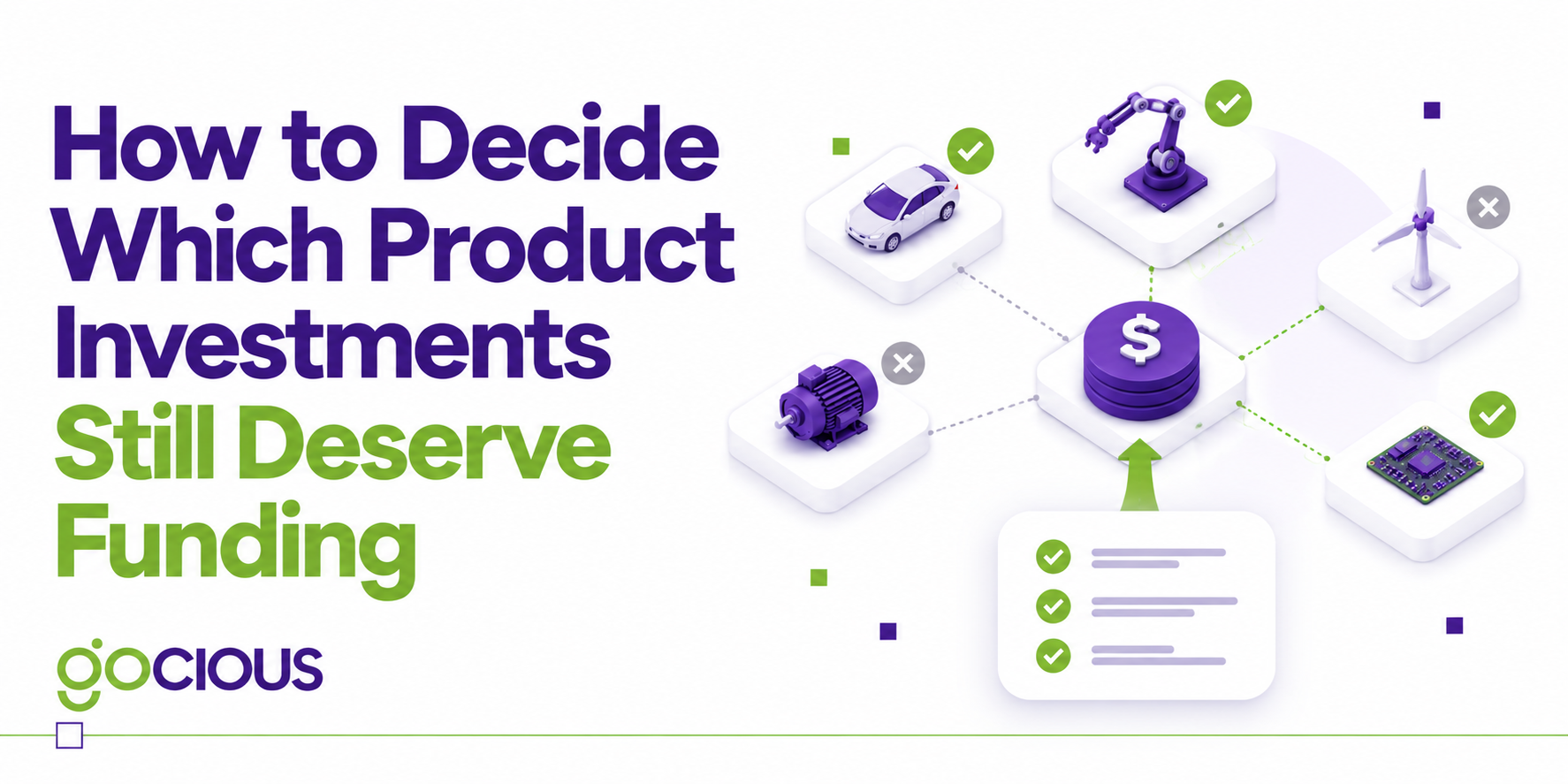
Product Decisions in Manufacturing and Lifecycle Objectives
A strong product decision practice separates manufacturers that scale profitably from those that fight recurring delays, cost overruns, and quality issues. Every choice about architecture, features, variants, and the product's life cycle influences engineering workloads, supply chain stability, factory flow, serviceability, and the company’s portfolio economics.
How to Sunset a Product in Manufacturing with Examples
Most manufacturers can create a product launch plan quickly, but far fewer can outline how to sunset a product with that same level of clarity. A legacy product that lingers in the portfolio consumes capital, limits focus, and increases service complexity across regions and sales channels.
How Product Engagement Scores Drive ROI in Manufacturing
Manufacturers rely on clear, reliable indicators to understand how customers use their products, how adoption improves over time, and where product teams should focus their efforts. The product engagement score, often called PES, is one of the most valuable tools for capturing how many users engage with the product, how users interact with key features, and whether engagement trends support long-term growth.
The product engagement score measures adoption, stickiness, and expansion by combining three key metrics into a single view. This helps manufacturers evaluate user engagement with core features and understand whether users consistently return during a defined time period, such as daily, weekly, or monthly cycles.
Product Vulnerability Management: How to Assess Risk & Ultimate Checklist
Product vulnerability management has become a core leadership responsibility for manufacturers. As connected products combine hardware, embedded software, networks, and cloud services, even a single security vulnerability can pose significant risk to product performance, safety, and customer trust. Vulnerabilities can trigger recalls, exploited vulnerabilities in the field, breach events, and costly patch campaigns that disrupt roadmaps and consume resources.
How to Define Product Goals for New Manufacturing Launches
Product goals shape whether a new launch strengthens a manufacturing portfolio or slowly drains capital, time, and capacity. In global manufacturing environments, every new product locks the organization into tooling decisions, supplier relationships, and long-term software support. Unless those commitments align with clear product goals and a focused product vision, product teams risk shipping something that technically reaches the market but fails to reach revenue growth, customer satisfaction, or quality expectations.
How to Align Product Strategy with Company Goals in Manufacturing
For modern manufacturers, aligning product strategy with company goals has become essential for long-term success. When product roadmaps drift away from business objectives, organizations feel the impact through SKU proliferation, capital tied up in low-value variants, operational complexity, and declining margins. Misalignment creates a product portfolio that consumes resources without supporting revenue growth, market share, or measurable business outcomes.
The Product Leader's Guide to Manufacturing System Integration
Budget overruns, missed launch windows, and opaque quality trends persist when manufacturing system integration is treated as an afterthought.
The Role of Product Operations in Manufacturing | What is Product Ops
Product operations (product ops) is the CPO’s operating backbone: the mechanism that converts digital capital (PLM, MES, IoT, AI) into predictable throughput, margin expansion, and on-time launches across programs. When product ops is weak, portfolio bets stall in handoffs. Meanwhile, when it’s strong, strategy flows to the line and measurable results flow back.
Firmographic Segmentation for Manufacturing: 5 Steps to Define B2B Markets
In B2B manufacturing, serving the wrong segment isn’t just wasted effort; it can lock billions of dollars into products that miss the market. Firmographic segmentation minimizes that risk.
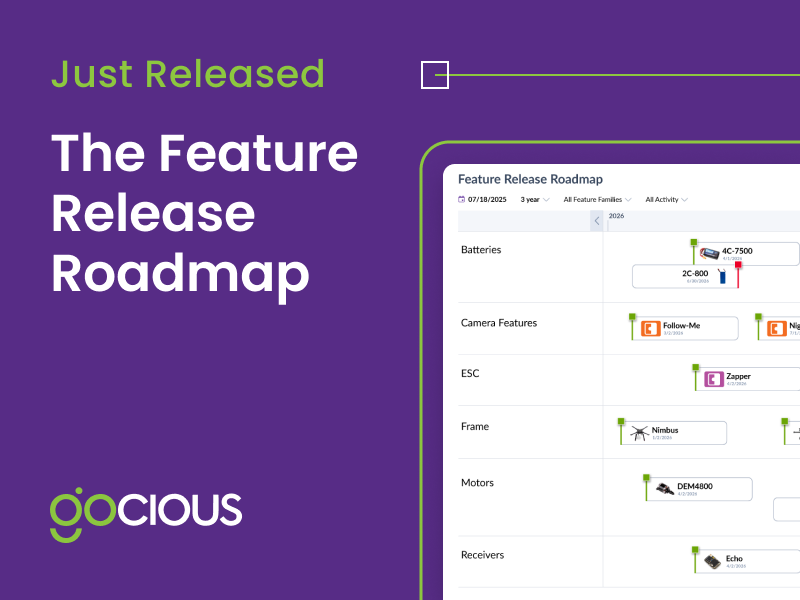
Just Released: The Feature Release Roadmap
For global manufacturers, developing physical products with intricate cyber-physical features requires significant capital investment and often spans lengthy timelines of 5-10 years. Additionally, hardware product cycles are characterized by deep interdependencies, long lead times, and the constant threat of product feature deprecation. These subassembly modules, which are referenced as features within the Gocious platform, are the integral product subsystems that go into the development and production of a finished product.
How to Align Manufacturing Teams with the Product Commercialization Process
Without proper team alignment during the product commercialization process, even the most innovative products can fail commercially. According to Deloitte's 2025 Manufacturing Industry Outlook, the average time-to-market for new industrial products spans 14 to 24 months. During this timeline, high-level decisions demand seamless coordination between manufacturing, engineering, production, marketing, and executive teams.
How Demand Management Aligns Product Strategy with Your Market in 2025
In today’s shifting manufacturing landscape, the gap between product strategy and market reality has never been more costly. Global manufacturers face unprecedented challenges: supply chain disruptions, turbulent demand volatility, and economic uncertainty that can render traditional forecasting methods obsolete overnight.