
Which product must adopt first?
Identify the first integration that later product plans rely on.
Lifecycle and dependency risk
Which product plans need review when a shared technology arrives later or stays in service longer?
Gocious connects those adoption and lifecycle assumptions to product plans, helping leaders see which launches, capabilities, and expected business contributions depend on the transition.
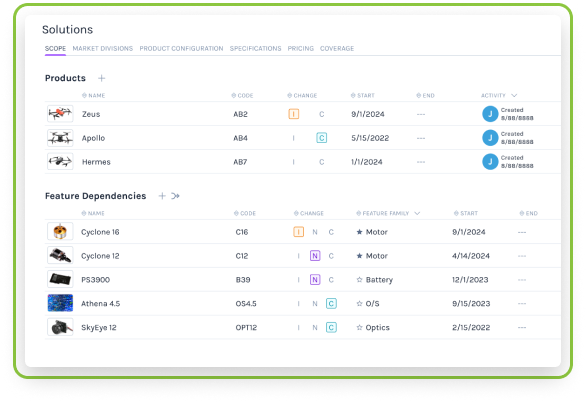
Lifecycle and dependency risk arises when connected product plans rely on adoption, availability, or retirement assumptions that may not hold. A change can affect products already in market as well as those preparing to launch.
Identify the first integration that later product plans rely on.
Review regional availability and support commitments before retirement.
Examine capabilities and expected contributions tied to adoption timing.
The first product delays or drops a new technology while following products still assume that integration will happen.
An existing generation stays active longer, carrying support costs and shared technology commitments with it.
The replacement arrives later, but other plans still assume the old generation has retired.
One market adopts the replacement while another still needs the existing product and its supporting technology.
Illustrative manufacturing example
An equipment manufacturer plans to introduce a new control module through Product A. That first integration is intended to establish readiness for Products B and C.
The first adoption moves nine months later. Its original integration milestone no longer supports the following plans.
The planned launch still assumes Product A’s first integration has established readiness.
The next introduction relies on the same sequence and now needs review too.
Leaders need to examine the following launches, the capabilities they introduce, and the expected contribution tied to those dates.
Hypothetical dates within the same year. First adoption does not by itself prove readiness for every following product; engineering teams assess the required validation.
Potentially preserve the rollout, while confirming another product’s readiness and ability to take on the first integration.
Preserve the intended validation sequence, while accepting later capabilities and expected business contribution.
Potentially preserve product availability, while extending support obligations and postponing planned benefits.
Compare when customer capabilities become available, which expected product contributions move, and how long existing generations need support.
Product, module, and portfolio leaders evaluate the options with engineering and delivery teams. Feasibility and the final choice depend on the situation.
Connect products, shared modules, technology roadmaps, and planned introductions or retirements.
Review the product families and regional commitments that rely on the same transition assumptions.
Examine relevant business estimates and transition options with the responsible product, module, and portfolio leaders.
Gocious is a strategic product portfolio planning platform for complex manufacturers. It connects planning relationships and business context; PLM and engineering systems retain detailed product definitions and validation records. Lifecycle availability here represents planning assumptions, not live inventory. External updates depend on configured integrations.
Related planning questions: One Trusted Portfolio View · Portfolio Drift · Decision Lag
Further reading: Lifecycle Planning in Product Portfolio Management · Shared Module Risk in Manufacturing Product Portfolio Planning
Lifecycle risk can arise when products remain active longer, generations overlap, regional transitions diverge, or replacement technology arrives later than planned. The portfolio consequence depends on which other products, support commitments, and expected business contributions rely on those assumptions.
Shared modules connect products with different adoption, availability, support, and retirement timelines. Later products may also depend on a first product establishing integration readiness. If that lead adoption changes, the following plans and their expected benefits may need review.
PLM manages detailed product definitions, engineering records, bills of materials, and formal change control. Product portfolio planning connects adoption and lifecycle assumptions with product roadmaps, regional commitments, and business context. Engineering teams retain responsibility for technical validation.
No. Many changes can be managed within existing product plans. A wider review becomes important when the change affects several products, a shared adoption sequence, regional support commitments, or the expected business contribution behind the plans.
Gocious connects product plans, modules, platforms, roadmaps, lifecycle assumptions, dependencies, and relevant business context. Leaders can examine the plans relying on a shared transition and assess which commitments or choices need review. The platform supports that review; it does not automatically validate engineering readiness or choose a response.
Bring one shared technology rollout or lifecycle transition. See which product plans, regional commitments, and expected benefits depend on it.