
 By
·
3 minute read
Gocious and Productboard both support product planning, prioritization, and roadmaps, but they begin with different planning problems.
For starters, Productboard is a strong fit for teams that need to turn customer feedback and product signals into priorities, specifications, and feature roadmaps. Meanwhile, Gocious is built for complex manufacturers that need to plan across connected products, platforms, modules, variants, lifecycle states, dependencies, and roadmap assumptions.
The right choice depends on what your planning system must help your team understand. Let’s break it down below.
Gocious vs Productboard at a Glance
|
Comparison area |
Gocious |
Productboard |
|
Primary focus |
Product and portfolio planning for complex manufacturers |
Customer-centric product management |
|
Best suited for |
Connected hardware, software, products, modules, variants, and lifecycles |
Customer feedback, product discovery, feature prioritization, and roadmaps |
|
Planning structure |
Products, platforms, modules, features, plans, variants, and lifecycle relationships |
Products, components, features, subfeatures, initiatives, and objectives |
|
Customer feedback |
Configurable demand boards, scoring, and connections to products or plans |
Centralized feedback, customer insights, portals, integrations, and AI-supported analysis |
|
Roadmaps |
Product, portfolio, module, feature, lifecycle, financial, and KPI views where configured |
Roadmaps for objectives, initiatives, products, releases, and features |
|
Dependencies |
Planning relationships across products, modules, plans, and lifecycles |
Dependencies and timing conflicts among initiatives, features, and subfeatures |
|
Delivery connection |
Jira Cloud and scoped data exchange through the Gocious Open API |
Jira, Azure DevOps, and other product-management integrations |
Keep in mind, capabilities and packaging can change. We suggest you confirm specific workflow requirements with each vendor.
What Is the Main Difference Between Gocious and Productboard?
Productboard connects customer signals to product ideas, features, priorities, objectives, and delivery workflows. Its feedback tools help teams collect input, connect relevant insights to product ideas, and use that evidence during prioritization. Its product hierarchy organizes work through products, components, features, and subfeatures.
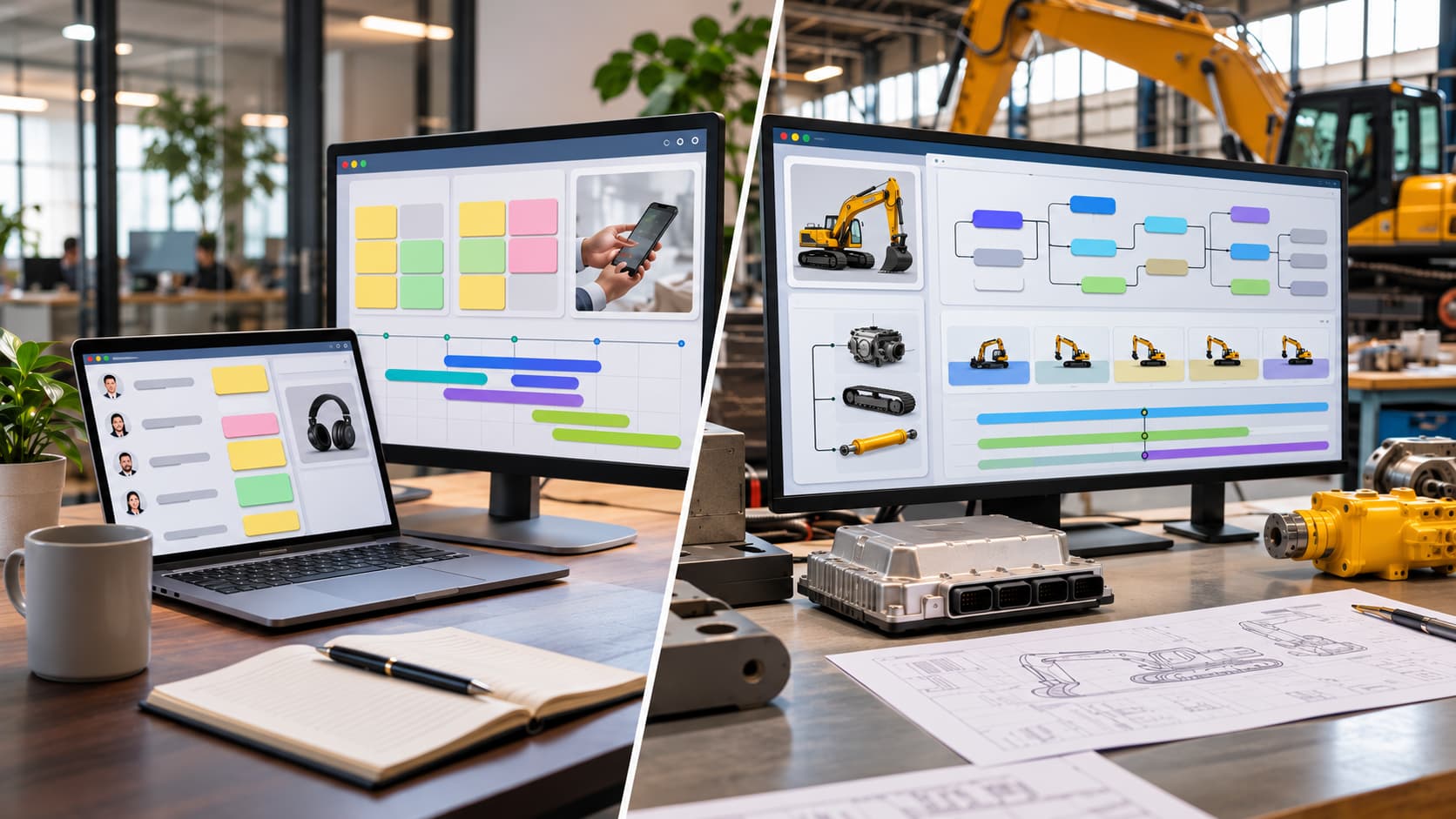
Gocious connects demand and priorities to the structure and lifecycle of a complex product portfolio. It helps manufacturers understand how products, modules, variants, plans, lifecycle states, and dependencies relate before making or revisiting a planning decision.
Quick Example: Connected Product Architecture with Gocious
Consider a shared controller used across several product lines.
Each product may have a different launch date, regional configuration, software dependency, and lifecycle obligation. The planning question is not only whether customers want a capability. The team must also understand where the controller is used, which plans depend on it, and what deserves review if its timing or availability changes.
This connected product architecture is central to the Gocious model.
Where Is Productboard Strongest?
Productboard has a strong customer-feedback and product-discovery proposition. Teams can collect feedback through multiple channels, connect insights to product ideas, prioritize opportunities, and communicate plans through roadmaps and portals.
The platform also supports feature-level dependencies, Jira synchronization, objectives, initiatives, and AI-supported product-management workflows.
Productboard may be the stronger fit when:
- Customer feedback is the primary input to product planning.
- The team organizes work mainly around objectives, initiatives, features, and releases.
- Product portals and broad feedback integrations are important.
- AI-supported product-management workflows are a priority.
- Complex manufacturing structure and lifecycle relationships are not central to the decision.
Want more information? Review Productboard’s documentation for feedback management, product hierarchies, and feature dependencies.
Where Does Gocious Fit?
Gocious is designed for manufacturers whose roadmaps become difficult to evaluate when products share platforms, modules, software, technologies, and lifecycle obligations.
It provides planning-level product structure without recreating the detailed engineering information held in PLM. Teams can connect demand and needs, products, modules, plans, roadmap timing, lifecycle information, dependencies, and selected business context in one planning environment.
When Should Manufacturers Use Gocious?
Gocious may be the stronger fit when:
- You manage complex manufactured or cyber-physical products.
- Products share modules, platforms, components, or software.
- Hardware and software operate on different timelines.
- Variants, regions, generations, or long lifecycles complicate planning.
- A product or module change can affect several plans.
- Portfolio reviews require current roadmap, lifecycle, and dependency context.
- Teams repeatedly reconstruct the portfolio picture from spreadsheets, slides, and separate systems.
Gocious does not replace PLM, ERP, an engineering BOM, or detailed project-management software. Its integration approach connects strategic planning with selected enterprise and execution systems while those systems retain their established responsibilities.
Proven in Complex Manufacturing
AGCO uses Gocious to support product planning across hardware, software, services, and global product lines.
Rodrigo Soeira de Souza, Director of Global Product Roadmaps Management and Product Investment at AGCO, describes Gocious as “a critical partner in our journey to success.”
The AGCO example demonstrates how connected product planning can support a global manufacturer without reducing the problem to another feature backlog or project tracker.
Choose the Platform That Fits the Decision
Choose Productboard when the primary job is turning customer signals into product priorities and feature roadmaps.
Choose Gocious when the decision depends on understanding how demand, products, shared modules, variants, lifecycles, dependencies, and plans fit together across a complex manufacturing portfolio.
See how Gocious would represent your product portfolio, shared modules, lifecycle states, and roadmap dependencies. Request a custom demo.